

THE RSVP PROBLEM
The difference between showing up for the conversation and taking responsibility for the culture.

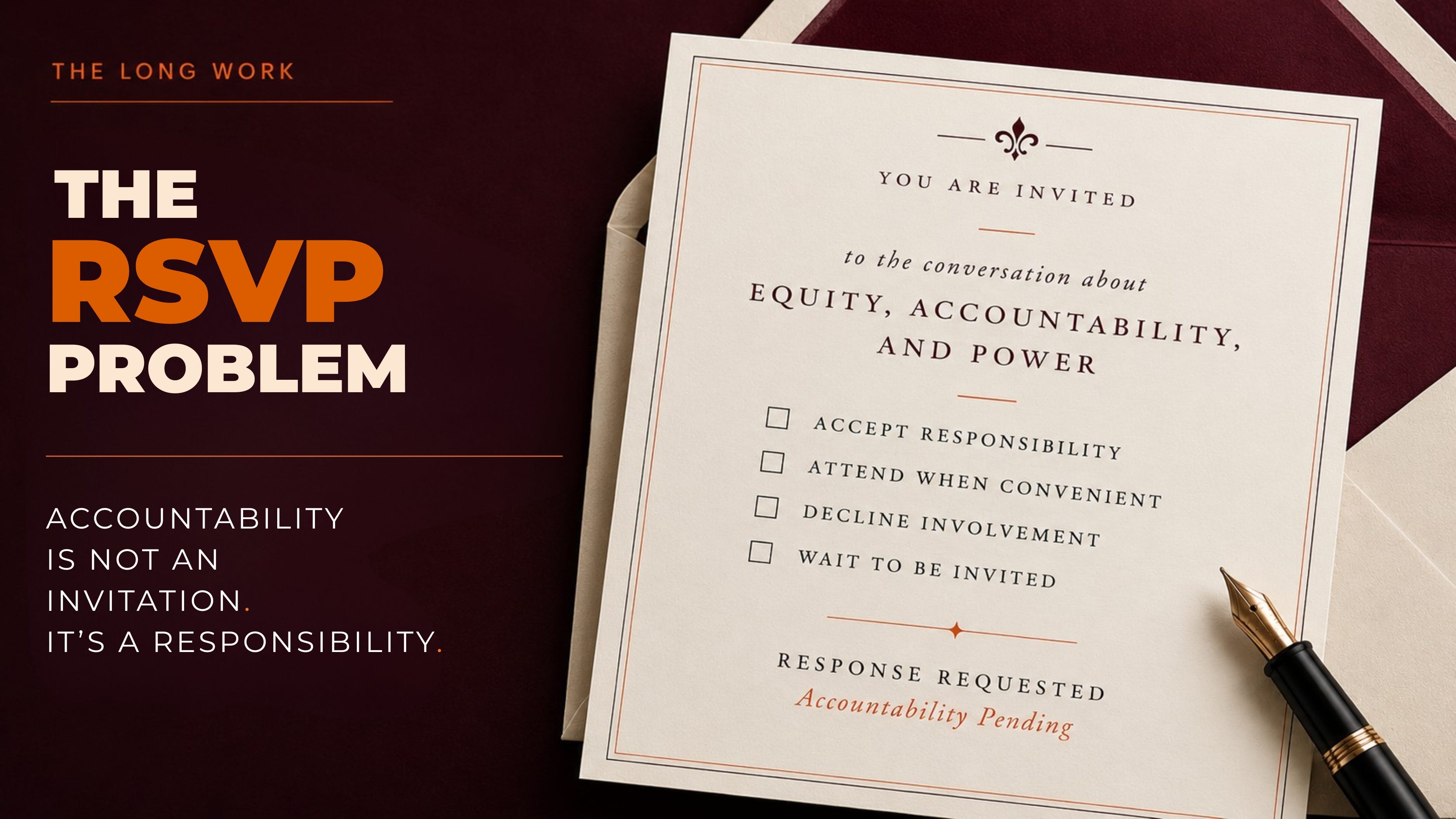
Lately, I’ve found myself increasingly irritated by a phrase I keep hearing in conversations about workplace DEI (diversity, equity, inclusion) and belonging:
“We need to bring men into the work.”
I understand why that language held.
For years, many organizations struggled to engage men in conversations about workplace equity. Defensiveness was high. Resistance was common. Some men saw inclusion work as something happening to them rather than something requiring participation from them.
I spent much of my career inside that reality.
At Catalyst, I helped lead and expand inclusion efforts, including MARC (Men Advocating Real Change), an initiative designed specifically to engage men in building more equitable workplaces and communities. We worked with executives, managers, and employees around the world to explore masculinity, leadership, sponsorship, bias, emotional intelligence, workplace culture, and accountability.
I still believe deeply in that work.
Men absolutely belong in conversations about equity.
But increasingly, I worry that some of the language surrounding this work has become so careful, so accommodating, and so optimized for buy-in that it has unintentionally softened accountability itself.
“Bring men into the conversation.”
“Invite men into the work.”
“Help men engage.”
At some point, the framing starts to sound less inclusive and more infantilizing. As though men are passive observers standing outside systems that disproportionately benefit them, simply waiting for a sufficiently compelling invitation to participate.
But men are not bystanders to workplace culture. Men are not external to systems of inequity. And men are not children waiting to be invited into moral responsibility.
Those distinctions matter. Especially now.
I attended an event recently where the keynote celebrated the importance of “bringing men into the inclusion conversation” because inclusion “works better for them too.”
I understood the intention immediately. I’ve used versions of that framing myself. Many practitioners have.
The argument is strategically effective because it lowers defensiveness, creates entry points, and helps skeptical leaders stay in the room long enough to begin learning.
And to be fair, the research behind some of this approach was real.
During early research connected to Catalyst’s Engaging Men initiatives, we found that many men stayed away from equity conversations for three primary reasons: fear, ignorance, and apathy.
Some feared what participation might say about them.
Some genuinely did not understand their role.
Some simply didn’t believe workplace equity had anything to do with them at all.
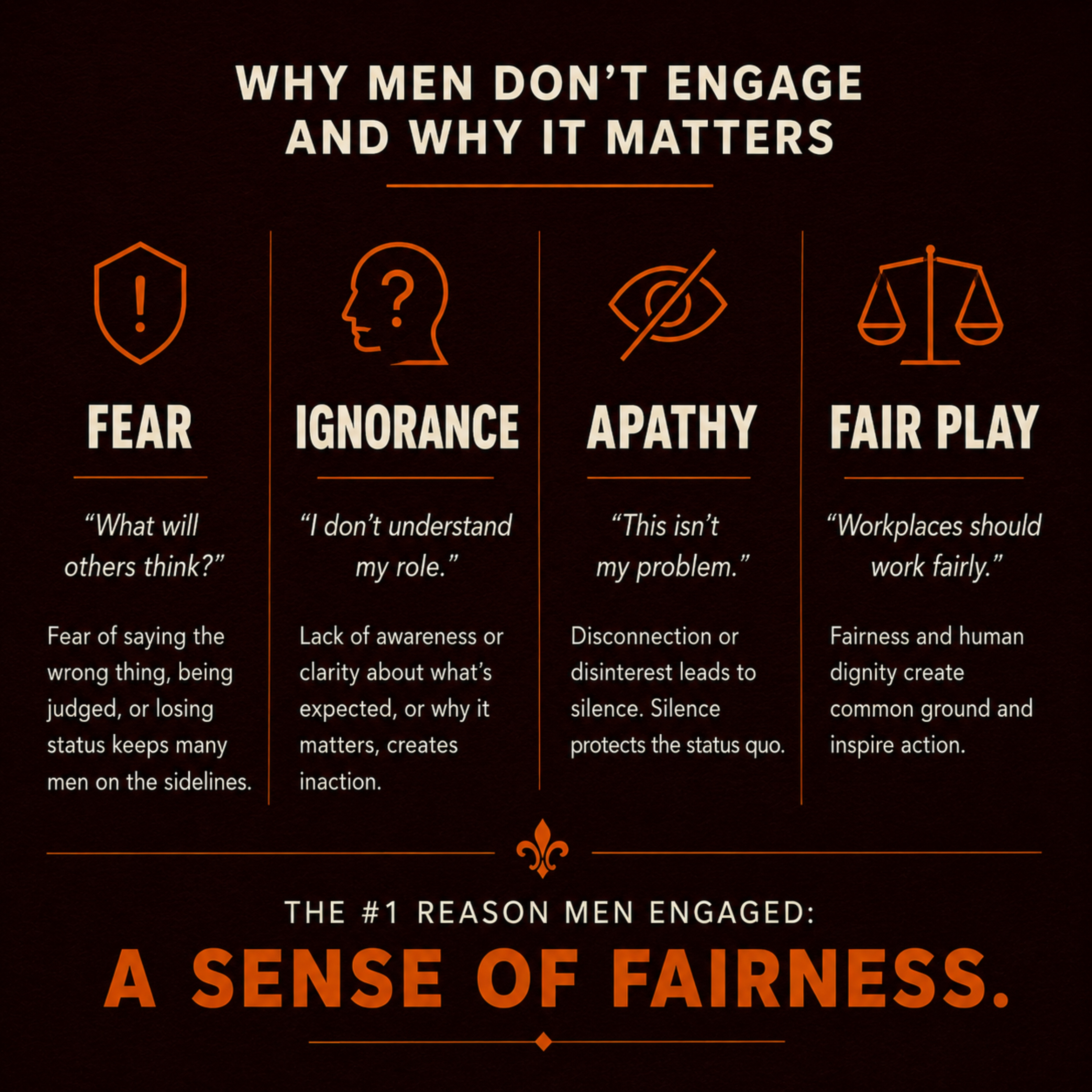
What moved many men toward engagement was not shame, but fairness.
The belief that workplaces should work fairly.
That opportunity should be distributed fairly.
That talent should be recognized fairly.
That people should be treated fairly.
The fight for women’s equality also reshaped my own understanding of masculinity, fairness, and power inside organizations and culture. What the Fight for Women’s Equality Taught Me About Masculinity
These insights mattered then, and I believe they matter now.
Because fairness cuts both ways.
Eventually fairness requires recognizing that systems built around disproportionate advantage may feel less comfortable to those who benefited most from them.
That is where many organizations — and many conversations — start to lose clarity.
Because while inclusion absolutely creates healthier workplaces, stronger teams, greater trust, increased innovation, and better business outcomes, equity work is not only about optimization.
It is also about accountability.
And accountability requires confronting a harder truth that organizations often struggle to say plainly:
More equitable systems sometimes redistribute forms of unearned advantage that certain groups have long experienced as normal.
That is not oppression. It is not punishment. And it is not anti-men to acknowledge it. But it is real.
If leadership becomes more representative, some people lose exclusive access to influence and opportunity.
If sponsorship networks become more equitable, some people lose automatic proximity to power.
If historically marginalized voices are amplified, historically dominant voices become less singular.
That is part of what equity does.
Not because one group must be diminished for another to thrive, but because systems built around disproportionate access eventually require correction.
And yet, much of the language surrounding workplace inclusion has become increasingly uncomfortable naming power directly.
Instead, organizations often retreat into softer, safer language:
“Everyone wins.”
“We all benefit.”
“Inclusion helps everybody.”
Again, there is truth in those statements.
But when inclusion work becomes entirely framed around universal comfort and universal gain, something important disappears:
the expectation of responsibility.
Back in 2019, I was featured in a New York Times piece about diversity efforts inside organizations. One quote from that conversation has stayed with me:
“For years, organizations incentivized inclusion with a carrot. They rewarded participation, but they didn’t hold people accountable for a lack of results. They were like, the program is enough. But now, we have to hold people accountable for results. We often say, ‘What gets measured gets done.’”
I think about that often now.
Because participation and accountability are not the same thing.
Participation can mean attending the workshop.
Learning the language.
Joining the panel.
Posting the statement.
Checking the box.
Accountability requires behavior change.
Power-sharing.
Interruption of bias.
Different sponsorship decisions.
Different hiring decisions.
Different succession decisions.
Different listening behaviors.
Different responses when exclusion happens.
And increasingly, I wonder whether some institutional approaches to engaging men unintentionally prioritized participation metrics over cultural accountability itself.
To be clear, I am not arguing against engaging men. Far from it.
I still believe masculinity matters. I still believe men have an essential role to play in building healthier, more equitable workplaces and communities. And I still believe many men are searching for better models of leadership, identity, and connection.
I also explored this directly in a piece examining why initiatives like MARC mattered in the first place. Why Masculinity Still Matters
The goal was never to shame men into silence. It was to help men understand themselves as active participants in shaping culture.
That remains true.
But participation is not the same thing as accountability.
And this distinction feels especially important in the current moment, as organizations face growing political, legal, and cultural scrutiny around DEI initiatives, including recent EEOC investigations and public debates about workplace equity efforts.
Some of that backlash is deeply opportunistic and politically motivated.
Some organizations also failed to communicate their intentions clearly and precisely.
Both things can be true at once.
When institutions stop speaking honestly about power, advantage, exclusion, and representation, a vacuum forms. And vacuums get filled quickly, and often by fear, distortion, resentment, or bad-faith interpretation.
That is part of what worries me now.
Not simply the backlash itself, but the erosion of clarity underneath it.
Because somewhere along the way, many conversations about equity stopped sounding like shared responsibility and started sounding like carefully managed persuasion campaigns designed to keep dominant groups comfortable enough to stay engaged.
But progress has never depended solely on comfort.
And moral responsibility does not require an invitation.
For years, organizations have treated equity work like a calendar invite men could choose to accept, decline, or ignore depending on convenience.
Maybe that was necessary for a time.
But accountability is not a networking reception.
It is not an optional leadership competency.
And it is not invitation-only.
At some point, men have to RSVP for themselves.
Sources + Related Reading
Michael J. Chamberlain, “What the Fight for Women’s Equality Taught Me About Masculinity”
Substack EssayMichael J. Chamberlain, “Why Masculinity Still Matters: What Initiatives Like MARC Reveal About Men, Leadership, and Inclusion”
LinkedIn Essay“The New Rules of the Diverse Workplace” — The New York Times (2019)
featuring commentary from Michael J. Chamberlain on accountability and inclusion outcomes
New York Times ArticleCatalyst Research: Engaging Men as Gender Champions / MARC (Men Advocating Real Change)
Catalyst MARC Research & ResourcesRecent reporting on EEOC scrutiny and DEI-related investigations:
New York Times Reporting (2026)